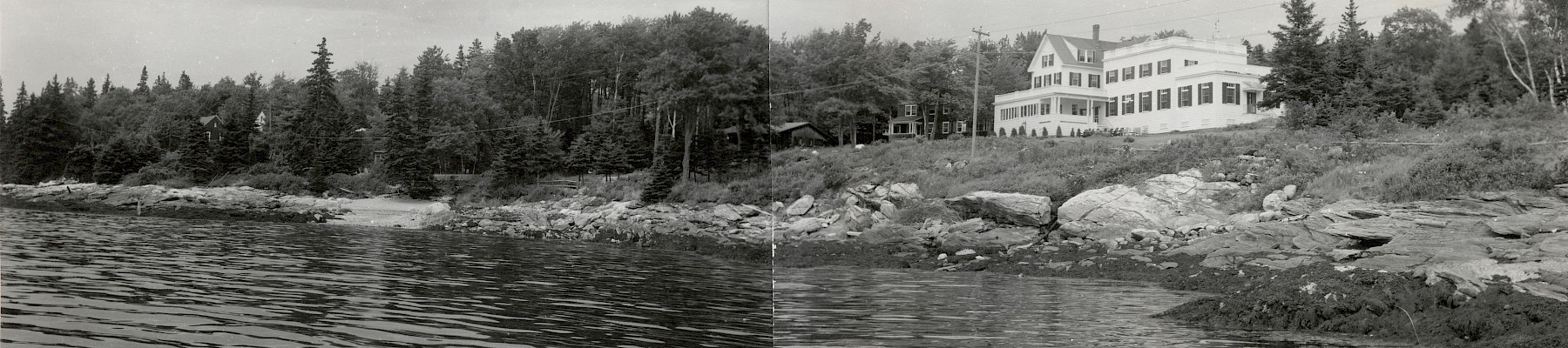
Spruce Point Inn’s story stretches back more than a century — from the rusticators and steamship travelers of the 19th century to generations of families who continue to return to the Maine coast each summer. Explore the people, traditions, and defining moments that shaped one of New England’s enduring seaside resorts.
Summer Shores of the Abenaki (Pre-Colonial)
Long before steamboats and summer homes, and before the European arrival in North America, the land now known as Spruce Point was part of the seasonal homeland of the indigenous people. For generations, they traveled the waterways of what is now midcoast Maine, settling in coastal areas like Boothbay Harbor during the warmer months to fish, forage, and gather. These lands — forested, abundant, and surrounded by ocean — offered a pleasant and bountiful retreat for these original inhabitants to sustain themselves through the summer climate. Though much has changed, the enduring rhythm of returning to this coastline each summer connects the present to a far older tradition of seasonal life along Maine’s shores.

Arrival of the Rusticators (1870–1888)
In the late 19th century, the Maine coast offered more than beauty — it offered escape. By the 1870s, steamer service to Boothbay Harbor brought travelers north from Boston and New York, eager to exchange summer heat for sea breezes, fishing lines, and shaded porches. These early visitors were known as “rusticators” — urban professionals drawn to the thrill of the wild and the rituals of relaxed refinement: hunting and fishing by day, fine whiskey and conversation by night. The undeveloped land around Boothbay Harbor, including Spruce Point, was the site of fishing and hunting camps each summer, catering to visitors in pursuit of striped bass, small game, and the healthy Maine air.

The Boston & Boothbay Land Company (1888–1892)
Sensing both cultural shift and commercial opportunity, a group of investors formed the Boston & Boothbay Land Company in 1888 and purchased land on the east side of Boothbay Harbor, including 140 acres for a summer colony on Spruce Point. On it, they built a clubhouse for their future summer colony.
“The Boston & Boothbay Land Co. owns about 140 acres of land comprising the end of Spruce Point, a valuable summer resort property. It has been carefully surveyed with broad streets and avenues laid out. A steamboat wharf has been built, some of the streets and avenues have been graded, and a clubhouse has been built. With these two land companies in active operation, Boothbay Harbor is bound to grow rapidly as a summer resort.”
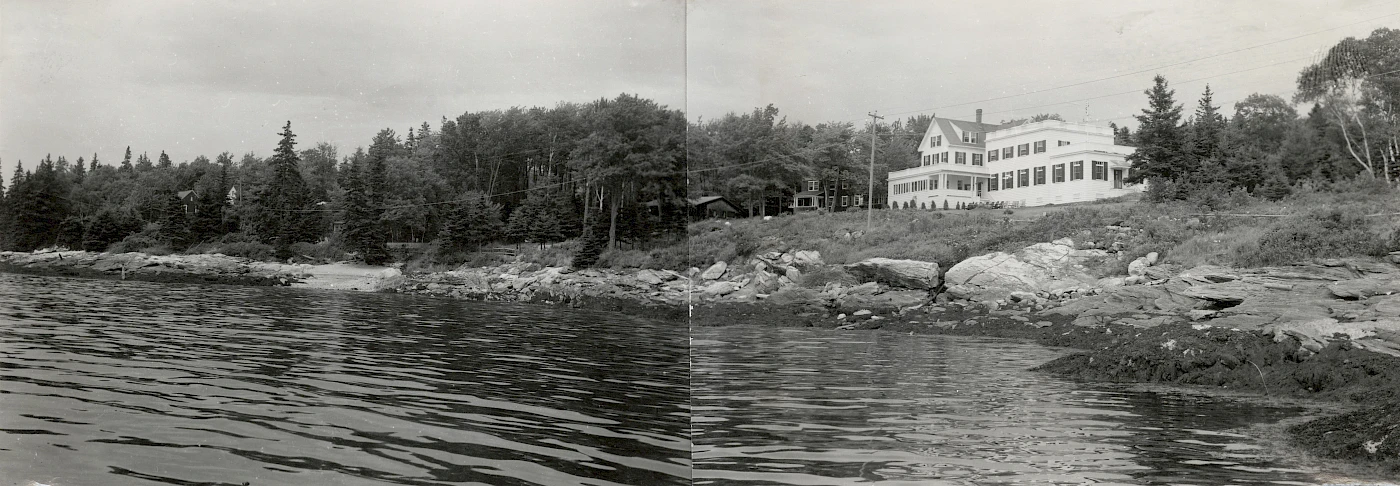
The clubhouse building that the Boston & Boothbay Land Co. built is the original core of the building you stand in today, our historic Main Inn. As the first building constructed in their grand scheme, the company used the clubhouse to host prospective buyers on hunting and fishing trips over which the guests would be wined, dined, and wowed by the same incredible views and stunning sunsets that we enjoy today.

The Marston Years: Spruce Point House (1892–1902)
In spite of stunning ocean views from every corner of their new real estate holdings, The Boston & Boothbay Land Company had a water problem. The town water supply extended only to the site of the company’s new clubhouse, limiting its ability to fulfill their full vision, requiring the partners to change course until their water woes were solved. Their woes wouldn’t be solved until 1919; as a result, much of the company’s original coastal woodland remains undeveloped.
Making the best of the situation, and capitalizing on the reputation for hospitality that the so-called Spruce Point House had earned, the company appointed one of their own men, Charles A. Marston from Skowhegan, ME, to operate the company clubhouse as a summer hotel, formally christened Spruce Point House. The early guests — friends, clients, potential land buyers, and increasingly the general public — were part of a broader movement to “rusticate” along Maine’s coast. At once adventurous and social, the lodge embodied the spirit of early coastal hospitality: unpolished, unpretentious, and unforgettable.
An 1890 edition of the Maine Industrial Journal reports:
“The annual meeting of the Boston & Boothbay Land Co., was held Friday, Feb. 21st, at the Preble House, Portland. Officers were elected as follows: President, Selden Connor; Vice President, Manley T. Pooler; Treasurer, Sanford C. Chase; Clerk, Charles A. Marston; Attorney, J. W. Spaulding. The company will make extensive improvements on their land at Spruce Point, Boothbay Harbor, and will make an addition to the Spruce Point House. Several cottage lots have been sold to be built upon this season.”

The Hollands: Tea, Tennis, and Tradition (1902–1946)
In 1902, the hotel was rented by Mrs. Sarah Holland, who expanded its appeal by opening a public tea house in the dining room. Ten years later, her son, Walter Holland — then president of the Atwater Kent Radio Company — purchased the property for her and rechristened it Holland House.
Under the Holland family’s stewardship, the inn thrived. Summer occupancy reached 100%, and a coveted waitlist became a rite of passage. Known for its charm and decorum, the inn enforced house rules with gentle rigor: no swearing, no picking flowers. Guests passed leisurely days in wicker chairs on wide porches, played tennis on clay courts, gathered fresh eggs from the coop, and spent quiet evenings in the newly built recreation hall, later known as the Lighthouse. Additions like Balsam Lodge and the inn’s defining architectural features helped shape its lasting identity.
Among the notable guests of this golden era was Ernest Hemingway, who spent time in one of the inn’s cottages on the peninsula. He reportedly took a particular liking to the wooden lawn chairs — simple, low-slung, and perfectly angled to catch the sea breeze. Their design endures at Spruce Point to this day, a quiet tribute to both tradition and taste.
The Transition Years: From Hollands to Harolds (1946–1957)
After World War II, the Hollands sold the inn to its then-manager, Leroy Race. The SPI experience remained steady — $9 per night with a full American Plan (breakfast & dinner included), summer after summer. But by the mid-1950s, the property began to show signs of fatigue. The era of automobile travel was changing how and where Americans vacationed, and the Inn’s aging infrastructure left it vulnerable to decline.
It was during this period that a neighbor, Raymond P. Harold, took notice. A banking executive from Massachusetts and a longtime Boothbay summer resident, Harold saw both the history and the potential in Spruce Point.

The Harold & Druce Era: A Golden Revival (1957–1988)
In 1957, Raymond Harold purchased the Inn, rechristened it Spruce Point Inn, and entrusted it to his daughter Charlotte and her husband John Druce. Though that first summer welcomed just three guests, the couple would go on to lead Spruce Point Inn through a remarkable 31-year renaissance.
They expanded the footprint with new cottages and the Evergreen Lodge, built a saltwater pool, and ringed the beach with a hand-laid stone wall. Dining remained central — jacket-required dinners in the main room, early bird breakfasts out on the point, and the opening of the Whistling Whale cocktail lounge. The guest list included not only loyal families, but a constellation of public figures: Vice President Hubert Humphrey, Robert and Edward Kennedy, John Glenn, Andy Williams, Claudine Longet, Rowland Evans, Ernest Hemingway and more.
It was a period of comfortable elegance, community, and continuity. Guests returned year after year. Traditions deepened. And the Inn became, in every sense, a summer home.


From Mackey to Mallett: Decline and Rescue (1988–1991)
When the Druces retired, the Inn was sold in 1988 to developer Jim Mackey and innkeeper Dick Razor. Under their brief ownership, new condominiums were built and development expanded, but the soul of the property faded. SPI began to fall into disrepair — its timeless character threatened by short-term changes and shifting priorities.
In 1991, a new team stepped in with a different vision. Ernest Mallett and Bruno DiGiulian, joined by partners Joseph Paolillo and Angelo DiGiulian, purchased the Inn and began restoring its heritage with thoughtfulness and respect. They reinvested in both the physical structures and the cultural traditions, reestablishing Spruce Point Inn as a beloved New England resort that honored its history while evolving for future generations.
The Present: A Timeless Retreat (2019–Today)
In 2019, family-owned and operated Stonehouse Capital acquired Spruce Point Inn, presering its historic character and enhancing its traditional Maine charcater.
Recognized as one of Conde Nast Traveler’s best resorts in New England and Down East Magazine’s Best Hotel in Maine for four consecutive years, Spruce Point Inn endures not because it clings to the past, but because it carries it forward — with grace, vitality, and that same salt-kissed spirit that first brought rusticators here more than a century ago.
With more than 80 accommodations across historic lodges, oceanfront cottages, and woodland townhomes, the Inn remains what it has always been: a place where generations gather, traditions continue, and oceanside memories are made.